

Last updated: November 12, 2026
Dysport before and after photos can show softer frown lines when the same person makes the same expression before treatment and after the effect has developed. A natural-looking result may still leave some lines visible, especially lines present when the face is relaxed. At La Belle Vie MedSpa, our Dysport injections in Seattle are planned around your facial movement and goals.
What do Dysport before and after photos show for frown lines?
Which changes should you look for when the person frowns?
Look at the furrows between the eyebrows in matching frowning expressions. Dysport temporarily reduces movement in the targeted muscles, so the furrows may look less pronounced when the person tries to frown. A phase 3 clinical study of 520 Chinese patients with moderate-to-severe frown lines found higher day-29 response rates with Dysport than with placebo, but the group result cannot predict any individual patient’s photograph.
What might stay the same after Dysport?
Skin texture and facial features do not necessarily change when movement-related lines soften. A relaxed-face photo is useful alongside a frowning photo: the pair helps distinguish a change in muscle-driven creasing from a change in a line that is already etched into the skin.
Can you see authentic patient examples without assuming the same outcome for yourself?
You can request consented patient photos for the area you are considering, if available. They can help you describe a preferred look, but another person’s anatomy and response do not establish what your result will be.
How can you tell whether Dysport photos represent a fair comparison?
An image taken immediately after injections cannot show Dysport’s full wrinkle-relaxing effect. Use a follow-up image taken after the effect has developed, and check whether other procedures may have affected the treated area.
Why do matching expressions, lighting and angles matter?
A frowning “before” image compared with a relaxed “after” image can exaggerate the apparent change. Shadows and camera position can also make a crease look deeper or softer. When reviewing dysport before and after photos, use this checklist:
- Confirm that both images show the same person and the same treatment area.
- Compare a frown with a frown, or a relaxed expression with a relaxed expression.
- Check for similar lighting, angle and distance from the camera.
- Look for the date or treatment-stage label on the follow-up image.
How can other treatments affect a before and after comparison?
Filler, skin resurfacing and other treatments can change features that Dysport alone would not. If a photo shows smoother skin at rest as well as softer expression lines, ask which treatments were performed. Clear disclosure makes the image more useful when deciding whether Dysport addresses your particular concern.
How long does it take for Dysport to take full effect?
Because the effect develops over days rather than during the visit, use images taken around two weeks after treatment to assess the full result. We advise a follow-up at that time.
When might you first notice a change after treatment?
The phase 3 Dysport study in Chinese patients reported a median onset of efficacy of 2.0 days. That finding means an early change is possible, not that everyone will notice one on the same day. Our Dysport results timeline guide explores what to expect as the effect develops.
When should you assess your final result and schedule follow-up?
At La Belle Vie MedSpa, the following timeline guides photo comparisons and follow-up planning:
| Stage | What to expect |
|---|---|
| Early change | La Belle Vie MedSpa: effects typically begin within two to four days. |
| Full effect and follow-up | La Belle Vie MedSpa: assess the result and attend the advised follow-up at about two weeks. |
| Typical duration | La Belle Vie MedSpa: results typically last two to four months, vary by patient and may last less time for a lip flip. |
| Longer response in one study | In the phase 3 study of Chinese patients with moderate-to-severe frown lines, 17% of Dysport-treated patients still met the study’s responder definition of no or mild frown lines at six months. This was not the typical outcome. |
Which wrinkles can Dysport treat, and who is a good candidate?
The FDA’s Dysport prescribing information identifies its approved cosmetic use as temporary improvement of moderate-to-severe frown lines between the eyebrows in adults younger than 65. If that describes your concern, we assess your health, facial movement and goals to determine whether Dysport suits you. We also discuss off-label use in other cosmetic areas, including forehead lines and crow’s feet; results in those areas may differ from frown-line photos.
How does Dysport soften expression-related lines?
Repeated frowning contracts muscles between the eyebrows and folds the overlying skin. By reducing that targeted movement, Dysport can soften the furrows seen during a frown.
Can Dysport address forehead lines, crow’s feet or other concerns?
You can also ask us about a lip flip, brow lift or jawline treatment. Cleveland Clinic’s Dysport and Botox comparison explains how the products’ approved cosmetic treatment areas differ. We assess which muscle movement is creating your concern and what change is realistic for you.
What happens during Dysport injections and afterward?
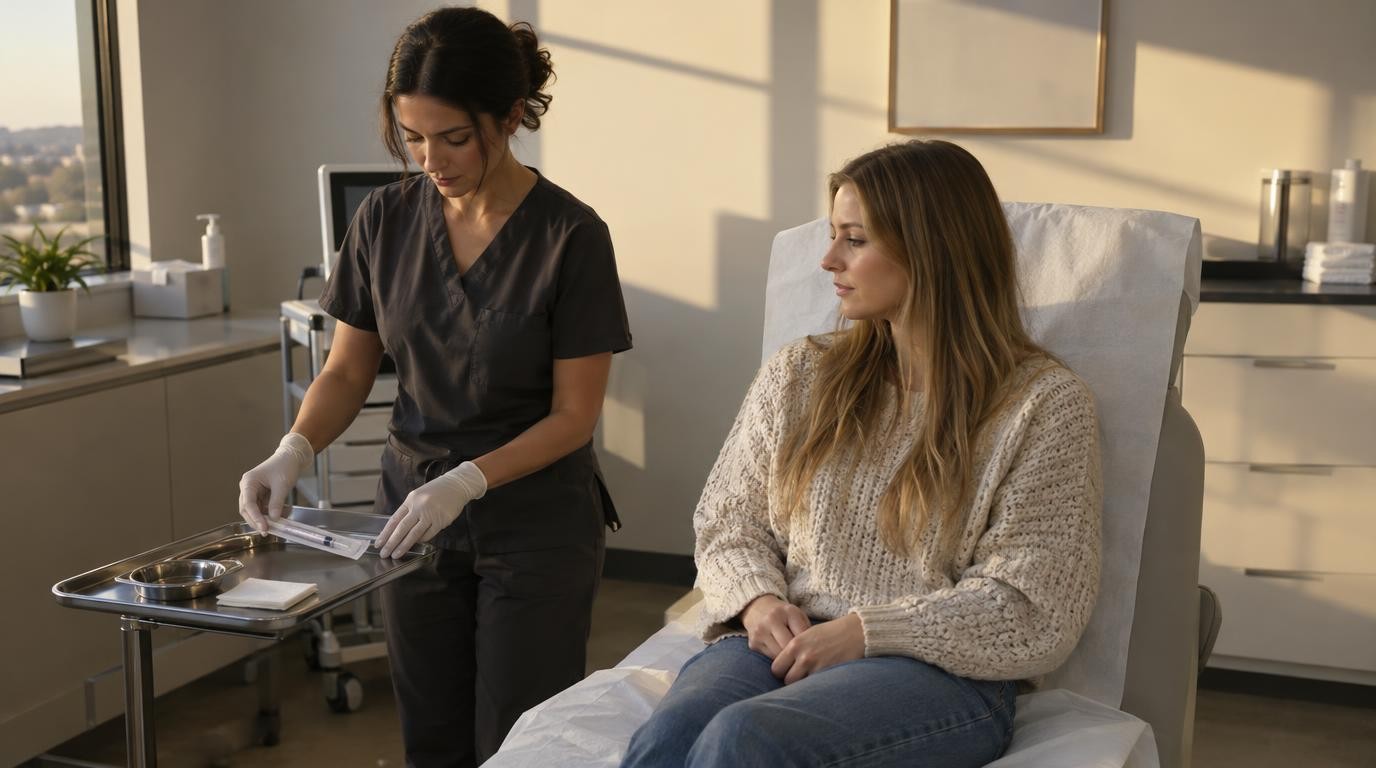
Our Dysport appointments last about 15 to 30 minutes. The visit generally follows these steps:
- We assess the area you want treated and the muscles involved in the relevant expression.
- We make multiple injections in the selected treatment area; each may feel like a mild pinch.
- After injections, we review the pre- and post-care instructions emailed to you.
What does a Dysport appointment feel like?
For FDA-approved frown-line treatment, the labeled regimen uses five injection points between the eyebrows, with 10 Dysport Units at each point for a total of 50 Units. Temporary tenderness at an injection site is possible.
What is the 4 hour rule for Botox, and does it apply to Dysport?
The commonly cited Botox “four-hour rule” refers to advice to remain upright for a period after Botox injections. It is not a universal Dysport instruction. An article on Cleveland Clinic’s website about Botox aftercare discusses staying upright for three to four hours after Botox while noting that some familiar aftercare restrictions have limited evidence. Follow the Dysport pre- and post-care instructions our team emails you instead of applying a Botox rule automatically.
When can you return to normal activities?
Most patients can return to ordinary daily activities immediately. Your individual instructions may include temporarily avoiding strenuous activity or rubbing and massaging the treated area. Review those instructions before leaving so you know what applies to your treatment.
What are the downsides of Dysport?
Dysport results are temporary, individual responses vary, and injections can cause side effects. Redness, swelling or bruising may occur; tenderness, discomfort, bleeding and weakness near injection sites are also possible. Rare but serious effects require immediate medical attention.
Which side effects should you discuss before treatment?
For frown-line treatment, the FDA’s Dysport prescribing information lists headache, drooping eyelids, eyelid swelling, injection-site pain or reactions, stuffy or runny nose and sore throat, sinus or upper respiratory infection, nausea, and blood in the urine among the most common reported side effects. Toxin effects can spread beyond the injection area, causing symptoms such as generalized muscle weakness, double or blurred vision, changes in voice, trouble speaking or swallowing, loss of bladder control, or trouble breathing within hours to weeks. Seek medical help right away if you have trouble swallowing, speaking or breathing or other symptoms of toxin spread.
Who should avoid Dysport or seek medical clearance first?
At La Belle Vie MedSpa, we advise avoiding Dysport while pregnant or nursing. Dysport should not be given if you have an infection at the proposed injection site or a known allergy to a botulinum toxin product or a Dysport ingredient, including cow’s milk protein. Before treatment, tell your clinician about muscle or nerve conditions, medicines such as muscle relaxants, and previous botulinum toxin injections so you can review the precautions that apply to you.
How do Dysport results differ from Botox or filler?
Compare what each treatment changes rather than assuming similar-looking photos show the same procedure:
| Treatment | What it changes | What photos may show |
|---|---|---|
| Dysport | Temporarily reduces targeted muscle movement; its FDA-approved cosmetic use is for frown lines between the eyebrows in adults younger than 65. | Softer lines during a frown after the effect develops. |
| Botox | Temporarily reduces targeted muscle movement; its FDA-approved cosmetic areas include frown lines, forehead lines and crow’s feet. | Softer movement-related lines in a treated area. |
| Dermal filler | Adds volume rather than reducing muscle movement. | A change in the volume or contour of a treated area. |
If by a “Botox facial” you mean Botox injections for facial wrinkles, yes: they can temporarily soften movement-related lines, but they do not correct every kind of line or provide permanent results. Cleveland Clinic’s discussion of Botox for wrinkles says its effects generally last about three to four months. In the phase 3 randomized trial of Chinese patients with moderate-to-severe frown lines discussed above, Dysport was non-inferior to Botox on the investigator-assessed day-29 response measure. That finding does not establish identical results for every patient or treatment area. Neither neuromodulator is universally better for every patient.
Does Dysport work the same way as Botox?
Yes. Dysport and Botox are botulinum toxin type A products that temporarily reduce targeted muscle contraction. A review of botulinum toxin products in Biologics: Targets and Therapy explains that their formulations and biological-activity assays differ, so their doses and performance are not interchangeable. Our Botox, Dysport and Daxxify comparison offers more context about the options.
Is Dysport a filler for lines that remain at rest?
No. If a frowning crease softens but a line remains prominent when your face is relaxed, more muscle relaxation alone may not address it. A volume-adding filler or a skin treatment may address a different concern, depending on the feature you want to change.
How can you plan a Dysport consultation in Seattle?
What should you bring up when discussing your goals and photos?
Show which lines bother you when you frown and which remain when your face is at rest. If you bring photos, identify the specific change you like rather than asking for an identical result. Share relevant medical history and ask how the proposed treatment area, expected effect and aftercare relate to your own facial movement.
How far ahead of an event should you book treatment?
At La Belle Vie MedSpa, we recommend scheduling Dysport at least two weeks before an event or trip to allow for the full effect and possible bruising. When choosing your date, also account for the follow-up described above.
Frequently Asked Questions
Where can I see Dysport before-and-after photos from plastic surgeons?
The American Society of Plastic Surgeons has a before-and-after gallery of botulinum toxin procedures performed by its members. Confirm which product was used before treating an image as a Dysport example, and remember that another person’s result cannot predict your own.
How soon can I get Dysport injections again?
For frown lines, the FDA prescribing information says Dysport should be administered no more frequently than every three months. Our results typically last two to four months, so the effect may last longer than the minimum interval between treatments.
Can I drive home after Dysport injections?
Usually, yes. Do not drive if you develop weakness, blurred vision or drooping eyelids. The FDA medication guide warns that these effects can occur within hours to weeks and may make driving or operating machinery unsafe. Seek medical help promptly for trouble swallowing, speaking or breathing.
Can Dysport make my eyebrows look uneven or droopy?
Yes. Eyebrow asymmetry or drooping can occur after Dysport injections, as Cleveland Clinic notes. A photo showing a change in brow position may reflect an unwanted change in nearby muscle movement rather than wrinkle improvement. Contact your treating clinician if you notice a new droop or unevenness.
Is Dysport FDA-approved for frown lines in adults 65 or older?
No. The FDA prescribing information identifies Dysport’s cosmetic indication as temporary improvement of moderate-to-severe frown lines between the eyebrows in adults younger than 65. Treatment at age 65 or older would be outside that approved cosmetic indication; the age limit alone does not determine whether treatment is appropriate for an individual.
Can Dysport be reversed if I don’t like the result?
Dysport cannot be dissolved or immediately switched off after injection. Its effect gradually wears off. If you’re concerned about your result, contact our team so we can assess it.
Can I get Dysport if I recently had Botox or another wrinkle-relaxing injection?
Tell your clinician before getting Dysport. The FDA prescribing information says the effects of using different botulinum toxin products at the same time or within several months of each other are unknown, and another treatment could worsen excessive muscle weakness. Share the product used and when you received it so your clinician can assess the risks.
What is the next step if you are considering Dysport?
To discuss your goals and any photos you would like help interpreting, contact La Belle Vie MedSpa in Seattle for a Dysport consultation. Our team can review the treatment area with you, explain realistic possibilities and help you plan around your schedule.
This information is general and is not medical advice. Talk to a licensed clinician about your own situation before making a treatment decision.
