

Last updated: November 9, 2026
Radiesse before and after photos may show an immediately softer treated facial fold or added fullness on the backs of the hands. Swelling can affect a same-day photo, and the appearance may change afterward, so that image is not necessarily the settled result. Photos cannot predict your outcome. If you are considering Radiesse treatment at La Belle Vie MedSpa, bring an example that reflects the change you want to discuss.
What Should Radiesse Before and After Photos Show?
Useful Radiesse before and after photos show the same patient at documented time points, with consistent front, profile, and three-quarter views when those angles are relevant. Matching lighting, expression, and head position make changes easier to assess. Labels should identify the treatment area, product, and any dilution; individual results can vary.
Why compare photos taken before treatment, around one month, and at six months?
A baseline photo establishes what changed. An early follow-up can show how the area looks after initial swelling has settled, while a later view can help document whether the result looks different over time. The FDA patient guide for Radiesse hand treatment discusses a possible touch-up at about two weeks to one month; the FDA summary for treatment of facial folds reports photographic assessment at six months. Neither document makes those intervals a required photo schedule for every patient.
Which angles and treatment details make a comparison trustworthy?
For hands, look for a similar position of the fingers and wrist. Check whether the patient had other treatments, whether the images were taken before or after a touch-up, and whether a diluted formulation was used. “Actual patient” and “Individual results may vary” disclosures help identify a case example, but they do not establish that its outcome is typical.
For a third-party example, the American Society of Plastic Surgeons Radiesse cheek case shows a patient before and after 1 cc of Radiesse was placed in the cheeks; both photos were taken on the treatment day. The case also lists a facelift, perioral dermabrasion, and a fat graft among its ancillary procedures without establishing when each occurred. The same-day images cannot show the settled result or isolate Radiesse’s contribution from those other procedures. This is not a La Belle Vie MedSpa result.
What Changes Can Radiesse Show in Different Treatment Areas?
Radiesse photos may show softer facial folds, a different lower-face contour, or less visible veins and tendons on the backs of the hands. The change worth assessing depends on the area and injection approach. A conventional volumizing result should not be judged by the same goal as a diluted treatment intended to improve wrinkles.
What can jawline and lower-face photos show?
In Radiesse jawline before and after views, look at the outline from the chin toward the ear in matched profile and three-quarter images. Lower-face photos may instead focus on smile lines or marionette lines. Changes in a photographed contour do not amount to a surgical facelift, and a favorable angle alone cannot establish how the face looks in motion.
The FDA summary for Radiesse (+) with lidocaine specifies deep injection for improvement of moderate to severe jawline contour loss. Product names matter when assessing a jawline example: a photo labeled only “Radiesse” does not tell you which formulation was used.
What can hand and hyperdilute treatment photos show?
Radiesse hand filler results are best assessed on the backs of the hands, where added fullness may make veins and tendons less conspicuous. A photo of the palm or a differently positioned hand would not show the same comparison.
The FDA patient guide for Radiesse hand treatment shows hands before treatment and three months afterward. It reports a two-point improvement for both hands on a five-point scale and cautions that individual results may vary. That three-month view documents a later result, not what every patient should expect.
Hyperdilute Radiesse before and after images call for another question: what was the dilution? Diluting the product changes how much immediate fullness a photo may show. A décolleté example labeled “diluted 1:2” identifies a specific mixture and area; it should not be treated as evidence that every diluted technique or body area has the same intended result or regulatory status.
How Does Radiesse Produce Immediate and Gradual Changes?
Radiesse is a calcium hydroxylapatite filler made of particles suspended in a gel carrier. The injected material can add visible fullness immediately, while the treatment may also stimulate collagen-related changes over time. The amount of immediate contouring and the appearance at later follow-ups depend on the formulation, dilution, placement, and patient.
What does calcium hydroxylapatite do after injection?
The FDA Radiesse patient information for facial folds describes calcium hydroxylapatite particles in a water-based gel and states that added fullness can be visible at the first treatment session. At La Belle Vie MedSpa, we use Radiesse to restore volume and support collagen production. A later photo can help assess the overall appearance, but it cannot measure an individual patient’s collagen production by sight.
How does dilution change what a photo may document?
Conventional placement aims to add contour or fullness where the product is injected. Dilution spreads the material through a larger treatment area, so a diluted-treatment photo may be intended to document wrinkles or skin appearance rather than the projection seen in a jawline photo. Always compare the stated treatment goal before deciding that one type of result is stronger than another.
When Will Radiesse Results Be Visible?
Radiesse can produce visible fullness at the treatment visit, but that first view may include swelling. At La Belle Vie MedSpa, we explain that results may continue to evolve over approximately six months; this does not mean every patient will see improvement throughout that period. Later photographs can help you assess the change.
How can early swelling affect a before-and-after comparison?
At La Belle Vie MedSpa, we advise that swelling may last two to three days after Radiesse injections and three to five days after jawline treatment. The FDA Radiesse instructions for use describe facial-injection reactions—mainly bruising, redness, and swelling—as generally lasting less than seven days, though recovery varies. Tenderness can also affect an early photograph. A same-day “after” image documents the immediate appearance, not necessarily the settled result.
How long does Radiesse last?
Cleveland Clinic’s dermal filler guidance describes Radiesse facial-filler results as lasting six months to one year. At La Belle Vie MedSpa, we note that results may last up to two years, but that upper-end duration is not guaranteed. Separately, the FDA hand-treatment guide says effects on the backs of the hands differ by person and may last up to one year. Ask about the expected duration for your treatment area rather than applying one figure to every Radiesse result.
Is Radiesse FDA-Approved for Every Area Shown in Photos?
No. FDA approval applies to specific Radiesse products and uses, not every location that can appear in a gallery. The FDA safety and effectiveness summary for Radiesse identifies correction of moderate to severe facial folds, treatment of HIV-associated facial fat loss, and restoration of volume on the backs of the hands among its indications. It also identifies Radiesse diluted 1:2 with sterile saline for décolleté wrinkles in patients aged 22 and older. That approval applies to the specified mixture and use; a photo labeled “hyperdilute” does not establish that the treatment matches it. Radiesse (+) with lidocaine has an indication for moderate to severe jawline contour loss. Uses outside the applicable product’s approved labeling are off-label.
Who may be a good candidate for Radiesse?
Adults seeking treatment for an appropriate facial fold, hand volume loss, or an applicable jawline concern may be candidates. Anatomy, medical history, and the desired change matter more than resemblance to someone in a photograph. The product and placement depend on whether the goal is added volume, contour, or improvement in skin appearance.
Which photographed uses need an individual discussion of off-label treatment?
Photos of Radiesse injections in the lips, under-eyes, or buttocks, isolated chin augmentation, or cosmetic cheek augmentation unrelated to HIV-associated facial fat loss call for an off-label discussion. A photo of one of these areas does not establish that the treatment is suitable for you. We explain the proposed use and its risks before treatment. The FDA Radiesse instructions for use state that safety and effectiveness in the lips have not been established and note published reports of nodules after lip injections.
What Happens During Radiesse Treatment and Recovery?
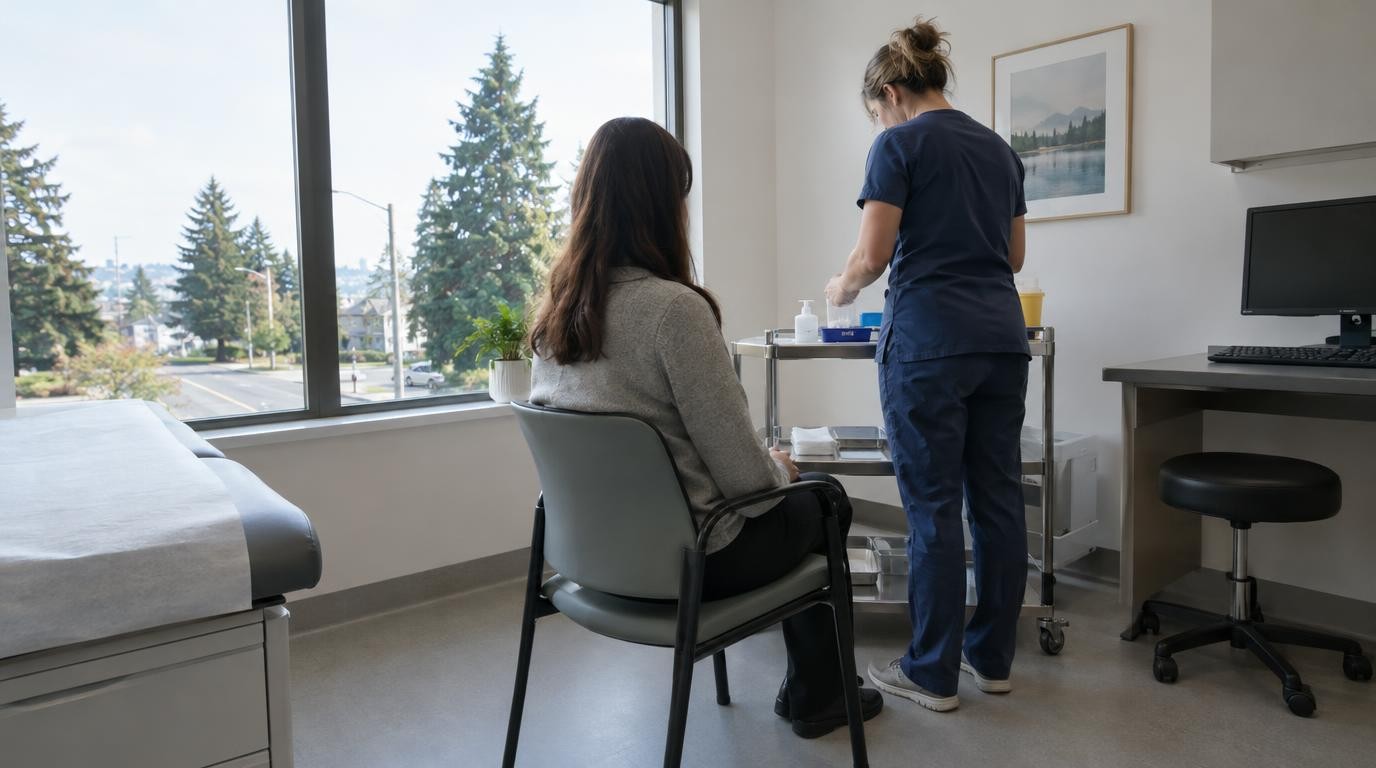
The visit follows these steps, with the formulation and placement chosen for the area being treated.
What should you expect at a Radiesse injection visit?
- Discuss the goal. A consultation identifies the feature you want to change and whether Radiesse is suitable for that area.
- Confirm the plan. The injector selects the product, placement approach, and dilution if applicable, then reviews the expected type of result.
- Receive the injections. We clean the area and place small amounts of Radiesse through a fine needle at selected sites; hand treatment may involve multiple injection sites. You may feel pressure or discomfort. We can discuss a topical or local anesthetic to reduce discomfort.
- Review aftercare. Instructions address expected local reactions and what to do if symptoms are concerning.
Can you exercise or wear makeup after Radiesse?
Our Radiesse treatments generally do not require planned downtime, but follow your injector’s advice for your treatment area before resuming exercise or other activities. Hand swelling or discomfort can temporarily limit what you can do: in the FDA hand-treatment study, 48% of patients reported difficulty performing activities. You can wear makeup afterward; gently remove it from injection sites with a mild cleanser at the end of the day.
What Are the Risks of Radiesse, and Who Should Avoid It?
Common Radiesse reactions include temporary swelling, bruising, redness, tenderness, and injection-site discomfort. Less common complications can be serious, particularly if filler enters a blood vessel. Discuss your history and risks with your own clinician before treatment.
Which side effects are common, and which symptoms need urgent care?
Minor injection-site bleeding is also possible. In the FDA hand-treatment study described in its patient guide, patients reported swelling (99%), pain (92%), redness (81%), bruising (73%), itching (46%), loss of sensation (15%), and bumps or lumps (6%). Most injection-related side effects lasted 14 days or less. These are hand-study findings, not rates for facial treatment. Infection is also possible.
Accidental injection into a blood vessel is uncommon but can interrupt blood supply and cause tissue death, vision loss, or stroke. Seek immediate medical evaluation for worsening or unusual pain, pale or dusky skin, other concerning skin-color changes, any visual symptom, sudden weakness, or trouble speaking after filler injection.
When should you postpone or avoid Radiesse injections?
The FDA Radiesse labeling lists a history of anaphylaxis or multiple severe allergies, hypersensitivity to Radiesse components, and bleeding disorders as contraindications. Postpone an elective injection if the planned site has an active infection. Tell us about aspirin, warfarin, or other medicines that prolong bleeding, which can increase injection-site bruising or bleeding, as well as prior filler reactions and recent procedures on the same skin. Also disclose any history of keloids, hypertrophic scars, or skin-pigmentation changes. The labeling says safety in patients prone to keloids or hypertrophic scarring has not been studied.
How Should You Compare Radiesse Photos With Other Filler Photos?
Compare Radiesse photos with other filler photos only when the treatment area, patient views, and timing are comparable. A result photographed after another filler cannot predict the shape, longevity, or recovery of a Radiesse result.
These differences matter when weighing the two types of filler:
| Point of comparison | Radiesse | Hyaluronic acid filler |
|---|---|---|
| Material | Calcium hydroxylapatite particles in a gel carrier | Hyaluronic acid; properties vary by product |
| What a photo may show | Fullness in a treated fold or on the back of a hand, depending on placement | Changes that depend on the particular product, area, and placement |
| Dissolving option | Cannot be dissolved in the same way as a hyaluronic acid filler | Can be dissolved with hyaluronidase when appropriate |
Why might a hyaluronic acid filler photo show a different result?
Product properties, injection depth, treatment area, and placement all affect what a filler photo shows. For example, we distinguish Radiesse’s thicker gel for deeper folds from Restylane, a hyaluronic acid filler that may be better suited to some fine lines. Hyaluronic acid fillers also differ from one another, so a result with one product is not a prediction for another. Our Radiesse and Juvéderm comparison offers more on those specific choices.
What should you ask before comparing two galleries?
- Are the same facial area or part of the hand shown?
- Are the before and after dates, angles, expression, lighting, and positioning comparable?
- Which product and formulation were used, and was Radiesse diluted?
- Did the patient receive a touch-up or another treatment between images?
For cheek examples in particular, distinguish a filler result from a broader plan to address facial volume loss. Our guide to restoring cheek volume without surgery provides context for that decision without making another patient’s photo a treatment plan.
Frequently Asked Questions
How do you pronounce Radiesse?
Radiesse is commonly pronounced “rah-DEE-ess.”
Does Radiesse show up on X-rays or CT scans?
Yes. Radiesse contains calcium hydroxylapatite particles that can appear on X-rays and CT scans. The FDA summary for facial folds found Radiesse more readily visible on CT than on X-ray. Tell your imaging team where and when you received filler so they can interpret the images with that history.
Can I wear rings after Radiesse hand injections?
Wait until hand swelling has resolved before putting rings back on. The FDA hand-treatment guide advises removing jewelry before injection and not wearing it again while the hands are swollen. If a ring becomes tight or stuck, seek prompt help rather than waiting for the swelling to resolve.
Can lumps after Radiesse hand filler last a long time?
Yes. The FDA hand-treatment guide says bumps or lumps in the hand may last up to one year. That possibility does not mean every lump is harmless or should be ignored. Contact your injector if a lump appears, persists, becomes painful, or is accompanied by redness or other concerning changes.
Can I get a laser treatment or chemical peel after Radiesse?
Possibly. FDA labeling warns that laser treatment or a chemical peel after Radiesse may cause swelling at the implant site. Receiving Radiesse before skin has fully healed from a laser treatment or peel may also trigger an inflammatory reaction; the labeling does not specify a single waiting period.
Is Radiesse safe during pregnancy or breastfeeding?
Its safety during pregnancy and breastfeeding has not been established. FDA instructions for use do not establish that Radiesse is safe in either situation, so postpone this elective treatment during pregnancy or breastfeeding.
Can Radiesse injections trigger a cold sore?
Yes. The FDA hand-treatment guide warns that Radiesse injection can reactivate herpes in someone with a history of it. Tell your injector about previous cold sores or other herpes outbreaks before treatment.
How Can Newcastle Patients Use These Photos at a Seattle Consultation?
Patients coming from Newcastle can bring a Radiesse photo example to a Seattle consultation and explain which specific change interests them. The useful questions concern product choice, treatment area, dilution, matched views, follow-up timing, and expected recovery. A consented, clearly labeled patient example may clarify a goal, but it cannot predict an individual result.
If an example catches your eye, identify whether you mean a smoother fold, more defined jawline, fuller hand, or change in skin appearance. Ask whether comparable, consented examples are available and what treatment details accompany them. To discuss which approach fits your goals, contact La Belle Vie MedSpa in Seattle for a Radiesse consultation.
This information is general and is not medical advice. Talk to a licensed clinician about your own situation before making a treatment decision.
