

Last updated: November 19, 2026
Botox around eyes can temporarily soften crow’s feet – the lines that appear at the outer corners when you smile or squint. Botox under the eyes is a different, off-label use, and neither placement removes true under-eye bags. At La Belle Vie MedSpa, our Botox injections in Seattle begin with an assessment of the lines you want to address.
What can Botox around eyes actually treat?
By temporarily relaxing the muscles that contract when you smile or squint, Botox can make crow’s feet at the outer corners less noticeable. Fine lines caused mainly by sun damage and creases caused by lost under-eye volume may show little or no improvement because muscle movement is not their main cause.
Is Botox for crow’s feet FDA-approved?
Yes. The FDA’s BOTOX Cosmetic patient information identifies temporary improvement of crow’s feet lines in adults as an approved cosmetic use. Approval applies to injections around the sides of the eyes; it does not mean every injection near an eye is approved or appropriate. An injector must assess the patient’s anatomy before deciding whether and where to treat.
Does FDA approval include Botox under the eyes?
No. Cosmetic injections into the lower eyelid are off-label, even though crow’s feet treatment at the outer corners is FDA-approved. The distinction is about placement, not simply how close the needle is to the eye.
Should you do Botox under your eyes?
Our Botox service includes treatment for fine lines below the eyes, but cosmetic lower-eyelid injections are off-label and may suit only selected adults whose lines become more visible during facial expression. Before considering treatment, an injector should assess lower-lid support, existing dryness or other eye symptoms, and the cause of the lines.
In an article on the American Society of Plastic Surgeons’ website, Tarick Smaili, MD, notes that some clinicians use Botox beneath the eyes for lines, while others avoid this off-label placement because of concerns about lower-lid sagging and difficulty blinking. Lines visible at rest may respond differently from lines created mainly by movement; lower-lid Botox does not fill hollows or remove puffiness.
Can Botox fix saggy eye bags?
No. Crow’s-feet injections may soften wrinkles around an eye bag, but they do not remove the bag’s protruding fat or tighten substantially loose skin.

How is Botox for crow’s feet different from treatment for eye bags?
The American Academy of Facial Plastic and Reconstructive Surgery explains that nonsurgical treatments can address some lines or hollows but cannot remove excess eyelid skin or reposition underlying fat. These approaches address different concerns:
| Concern | Approach to discuss | What it can and cannot do |
|---|---|---|
| Crow’s feet caused by expression | Botox beside the outer corners of the eyes | Temporarily softens lines; does not remove eye bags. |
| Fine lines mainly related to skin texture or sun damage | Laser skin resurfacing or chemical peels | May improve skin texture and fine lines; ask which option is suitable for the skin around your eyes. |
| Fine lines below the eyes | Botox in selected adults | May soften movement-related lines, but cosmetic lower-lid injections are off-label and may affect lid support or blinking. |
| Under-eye hollows | Dermal filler | Can add volume but does not remove protruding fat. |
| Prominent bags or substantially loose eyelid skin | Eyelid surgery | Can remove excess skin or reposition underlying fat; nonsurgical treatments cannot. |
What happens during Botox injections around the eyes in Seattle?
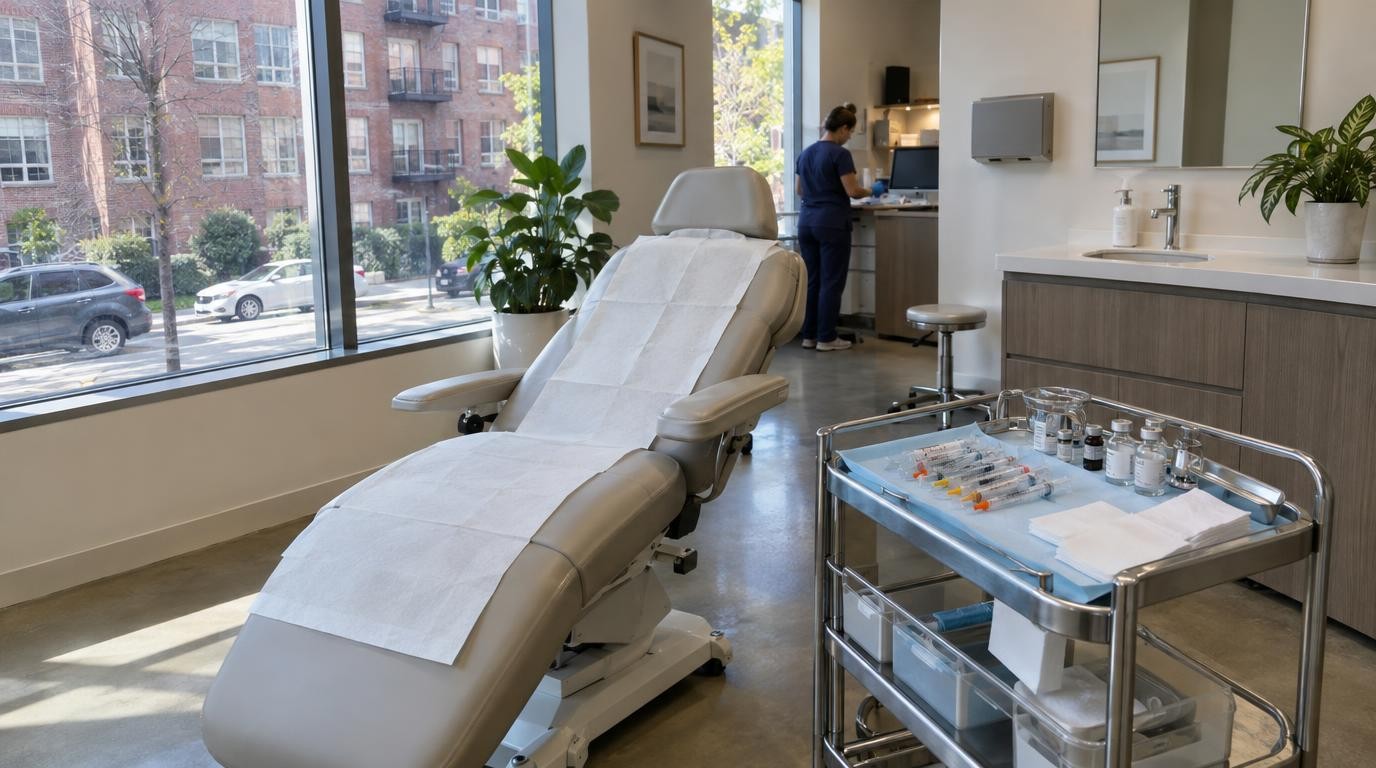
At La Belle Vie MedSpa in Seattle, we assess your facial expressions and map injection points before administering Botox in a private treatment room; the full process typically takes less than an hour:
- We may apply a topical anesthetic to the treatment area.
- We ask you to make facial expressions to map the areas and injection points suited to your goals.
- We administer a series of Botox injections at the mapped points.
Is there downtime after eye-area Botox?
You can usually return to routine activities immediately after Botox injections, although your injector may recommend short-term precautions. Mild injection-site redness or bruising typically clears within a day or two.
When do Botox results around the eyes appear, and how long do they last?
At La Belle Vie MedSpa, patients typically notice initial improvement in about five to seven days; results may continue to improve over the following two weeks. An article on the American Society of Plastic Surgeons’ website says crow’s-feet Botox may need repeating every three to six months to maintain results. Individual results vary and fade as muscle activity returns.
If you’re judging a possible outcome, our before-and-after photo gallery can show examples, but another patient’s result cannot predict yours. Readers comparing approaches to persistent lines can also see our guide to eye wrinkle creams and medspa treatments.
What are the risks of Botox around the eyes, and who should avoid it?
Eye-area Botox can cause eyelid or brow droop and dry eyes. The American Academy of Ophthalmology describes eyelid droop as less common but potentially vision-impairing and double vision as rare but serious. If you have a known allergy to botulinum toxin ingredients or an infection at a proposed injection site, you should not receive Botox, according to the FDA prescribing information for BOTOX. Milder injection-site effects include redness or bruising. Lower-lid placement deserves particular care because weakening nearby muscles may affect lid support and blinking.
The American Academy of Ophthalmology cautions that Botox near the eyes can worsen dryness and that lower-lid laxity should be assessed before injection. Neuromuscular disorders such as myasthenia gravis or amyotrophic lateral sclerosis (ALS) may increase the risk of significant muscle weakness and warrant special caution. Tell us about existing eye problems, other medical conditions, and all medicines and supplements you take. The American Academy of Ophthalmology’s guidance on Botox for eye conditions advises against Botox therapy for people taking aminoglycoside antibiotics, and the BOTOX Cosmetic prescribing information warns that interactions with other medicines can cause serious side effects. We can assess whether treatment should be deferred. Our guide to Botox side effects offers additional context.
What is the riskiest place for Botox?
There is no single injection point that is universally the riskiest for every person. Risk depends on placement, anatomy, existing eye symptoms, and the injector’s technique. In particular, treatment near the lower lid requires careful assessment because unwanted muscle relaxation can affect lid position or blinking.
Will my eyes go back to normal after Botox?
A Botox-related eyelid droop usually improves as the effect wears off, often over a couple of months, according to the American Academy of Ophthalmology. Do not wait for a new or persistent eye symptom to resolve on its own: contact a clinician promptly about new drooping, dryness, or other visual symptoms, especially double vision.
Botulinum toxin also carries a boxed warning about effects spreading beyond the injection area. Seek emergency care if you develop trouble swallowing or breathing, difficulty speaking, or widespread muscle weakness hours to weeks after an injection; the Centers for Disease Control and Prevention warns that symptoms of botulism after injections require emergency help.
Frequently Asked Questions
Do Botox injections for crow’s feet hurt?
Botox injections typically cause little pain because the needles are small, according to the American Academy of Ophthalmology. At La Belle Vie MedSpa, we may apply a topical anesthetic before treatment if you are concerned about discomfort.
Can I rub my eyes or lie down after Botox around the eyes?
The American Academy of Ophthalmology notes that your clinician may recommend staying upright and avoiding pressure on the treated area for about 4 hours after an injection. If given that instruction, do not rub the area during that time. The American Academy of Ophthalmology also notes that your injector may advise avoiding exercise for 24 to 48 hours after treatment; follow the directions you receive.
Can I get Botox around my eyes if I’m pregnant or breastfeeding?
Botox is not advised during pregnancy or breastfeeding, according to the American Academy of Ophthalmology. If you are pregnant or breastfeeding, defer cosmetic injections; if you are planning a pregnancy, share that information before treatment.
How can I tell an under-eye hollow from an eye bag?
An under-eye hollow typically appears as a depression or shadow, while a bag looks more like a bulge. Both can be present together. We assess the area in person to distinguish volume loss from protruding fat or loose skin before recommending a treatment.
Why might my eyes feel dry after eye-area Botox?
Botox can weaken the muscles used for blinking, making a blink less effective at spreading tears across the eye. Injections near the tear-producing gland may also affect its function and worsen dryness.
Is Botox for eye twitching the same treatment as Botox for crow’s feet?
No. Both use botulinum toxin, but treatment for eyelid spasms targets a medical muscle problem, while cosmetic crow’s feet treatment targets expression lines beside the eyes. The American Academy of Ophthalmology describes Botox treatment for eyelid spasms. If you have persistent twitching, seek an eye evaluation rather than assuming cosmetic injections will address it.
How can I check whether an eye-area Botox injector is qualified?
Ask whether the injector holds a valid healthcare license and has training in botulinum toxin injections. The CDC recommends checking your state’s license lookup tool where available. For eye-area treatment, also ask about the injector’s experience with your proposed placement and how they assess existing eye symptoms before injecting.
How can you decide whether Botox around your eyes is right for you?
Start by identifying whether your main concern is crow’s feet, fine lower-lid lines, hollows, or true eye bags. Ask whether the proposed placement is FDA-approved or off-label, what improvement is realistic, what risks apply to your eyes, and who will perform the injections.
- Show the concern in motion and at rest: Smiling may reveal crow’s feet that are less visible when your face is relaxed.
- Clarify the goal: Softer expression lines are different from removal of bags or loose skin.
- Understand the plan: Ask where injections would be placed and why that placement suits your anatomy.
If you would like to talk through your goals, contact La Belle Vie MedSpa for a Botox consultation in Seattle. Our team can assess the area that concerns you and explain whether Botox is a reasonable option, without promising a particular result.
This information is general and is not medical advice. Talk to a licensed clinician about your own situation before making a treatment decision.
About the doctors at La Belle Vie MedSpa
Dr. Tony Mangubat, MD – Board-certified cosmetic surgeon, chief surgeon and medical director since 1987.
Dr. Lena Weinman – Cosmetic surgeon (cosmetic surgery fellowship with Dr. Mangubat, 2024); board-certified by the American Osteopathic Board of Obstetrics and Gynecology.
